
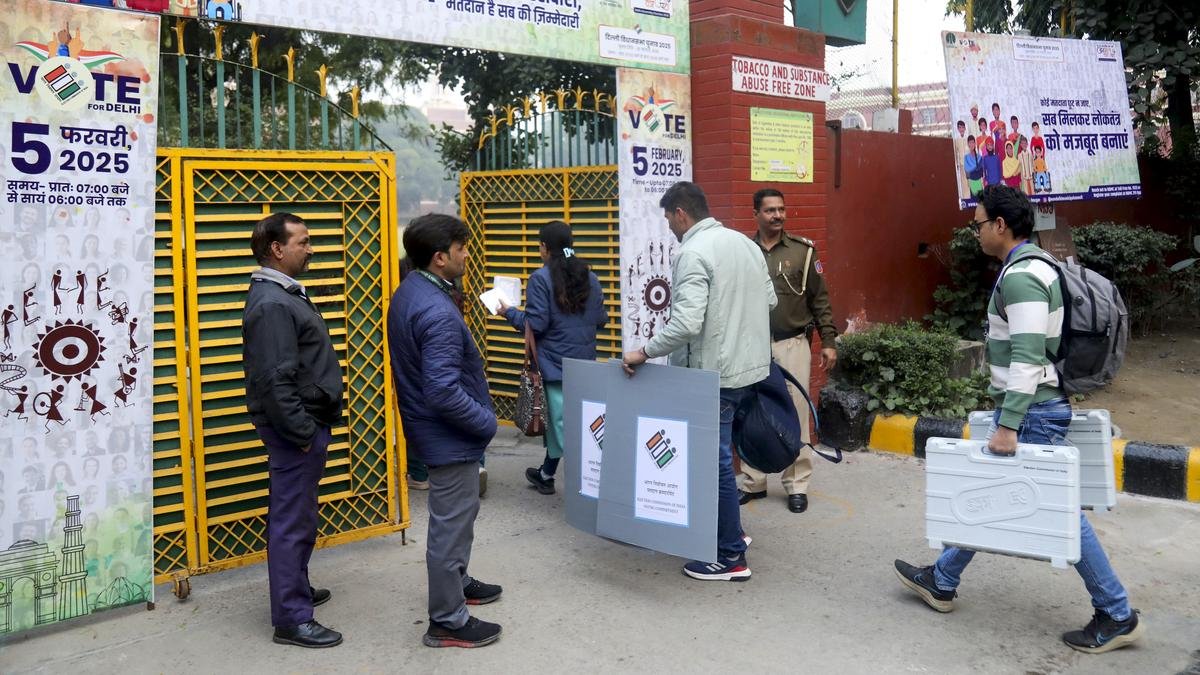
New Delhi: The fate of 699 candidates and the capital’s three major political parties is now sealed, as over 60.42% of Delhi’s 1.56 crore voters cast their votes on Wednesday to elect representatives for the 70-member Delhi Assembly.
This year’s turnout marks the lowest participation since 2008, when only 57.8% of eligible voters showed up at polling booths. In comparison, voter enthusiasm was significantly higher in 2013 (66%) and peaked in 2015 (67.5%). The 2020 elections saw a slight dip with 62.8% turnout, and the current figures reflect a further decline. However, the turnout is still 1.8 percentage points higher than the 58.6% recorded during the 2024 Lok Sabha elections, held in the peak summer month of May.
Election Commission: Turnout Figures Provisional
The Election Commission of India (ECI) clarified that the turnout numbers remain provisional and will be updated in the coming days. ECI Director Anuj Chandak explained that post-poll formalities, such as sealing Electronic Voting Machines (EVMs), preparing statutory documents, and distributing voter turnout data (Form 17C) to polling agents, delay the final count.
“Updated turnout data starts reflecting on the VTR App from 7 pm as returning officers feed in information once polling parties return from stations,” Chandak said. He also noted that occasional delays in document submission could lead to adjustments in turnout figures after further scrutiny or consideration of repolls.
Reasons Behind Low Turnout Remain Unclear
The dip in voter turnout has surprised many, considering Delhi’s reputation for an aware and active electorate. A senior election official acknowledged the lower-than-expected participation but urged patience until final numbers are confirmed.
“Several factors influence voter turnout, and often they are political. It’s too early to draw conclusions without the complete data,” the official added.
A Triangular Contest: AAP, BJP, and Congress
The elections saw an intense three-way battle between the Aam Aadmi Party (AAP), the Bharatiya Janata Party (BJP), and the Congress.
- AAP, aiming for a third consecutive term, highlighted its achievements in healthcare, education, and public welfare, including free electricity, water, and public transport rides for women. It promised expanded welfare programs for women, senior citizens, and marginalized communities.
- The BJP, out of power in Delhi for over 26 years, pledged to continue existing welfare schemes while introducing new free initiatives. With its central government backing, the party promised accelerated development projects under a “double-engine government” model.
- The Congress reminded voters of the Sheila Dikshit government’s developmental milestones from 1998 to 2013 and released a manifesto filled with free schemes for diverse sections of society.
Constituency Turnout Highlights
According to interim data, Mustafabad, a Muslim-majority constituency, recorded the highest turnout at 69%, slightly below the 70.8% recorded during the 2020 assembly elections but higher than the 66.8% turnout in the 2024 Lok Sabha polls.
Other key figures include:
- Seelampur: Second-highest turnout at 68.7%
- Seemapuri: 65.3% turnout
- Mehrauli: Lowest turnout at 53%
- Model Town: 53.4% turnout
Polling Day Timeline and Trends
Polling started at 7 am, with an initial turnout of 8.1% in the first two hours as Delhi’s chilly morning kept voters indoors. By 11 am, turnout rose to 20%, reaching 33.3% by 1 pm and 46.5% by 3 pm. By 5 pm, 57.7% of eligible voters had cast their votes, with polling officially closing at 6 pm.
Officials noted that queues started forming around 9 am, particularly in outer Delhi areas, where evening crowds suggested that the final voting percentage could rise slightly.
“Voters who arrived before the official close of polling were issued slips and allowed to vote,” an official confirmed.
Prominent Candidates in the Fray
The elections featured several high-profile candidates, including:
- AAP: Chief Minister Atishi, party supremo Arvind Kejriwal, former Deputy CM Manish Sisodia, and ministers Saurabh Bharadwaj, Imran Hussain, Mukesh Ahlawat, and Raghuvinder Shokeen.
- BJP: Senior leader Vijender Gupta, former MPs Ramesh Bidhuri and Parvesh Verma.
- Congress: Delhi Congress chief Devender Yadav, Sandeep Dikshit, Haroon Yusuf, and former ministers Kailash Gahlot, Raaj Kumar Anand, Arvinder Singh Lovely, and Rajkumar Chauhan.
Peaceful Polling and Next Steps
The vote counting is scheduled for February 8, and if a party secures a clear majority, a new government is expected to be formed by February 11.
The Election Commission reported that voting proceeded peacefully across all constituencies, with no incidents of violence.
“All 70 assembly constituencies of Delhi witnessed peaceful and orderly polling. Voters expressed satisfaction with the seamless process and facilities at polling stations,” said Anuj Chandak.
Chief Election Commissioner Rajiv Kumar, along with Election Commissioners Gyanesh Kumar and Sukhbir Singh Sandhu, maintained a thorough oversight to ensure the elections were conducted smoothly and fairly.
As Delhi awaits the final results, political observers are closely watching how the lower turnout might influence the outcome in this tightly contested election.